


Like I was living my life with the volume turned down on the parts of it that were supposed to feel like me.
For years, I did everything I was told.
Therapy. Reiki. Journaling. A chiropractor every few weeks. Massage therapy. Quarterly staycations because I read somewhere that rest was supposed to help. I was checking every box that wellness culture had laid out for a woman who was clearly carrying too much (e.g. a new mom, a new wife, a business owner, a decade into being responsible for everyone and everything at once). I was doing the work, and in true Capricorn fashion, I was taking it seriously.
And I still felt like I couldn’t find myself.
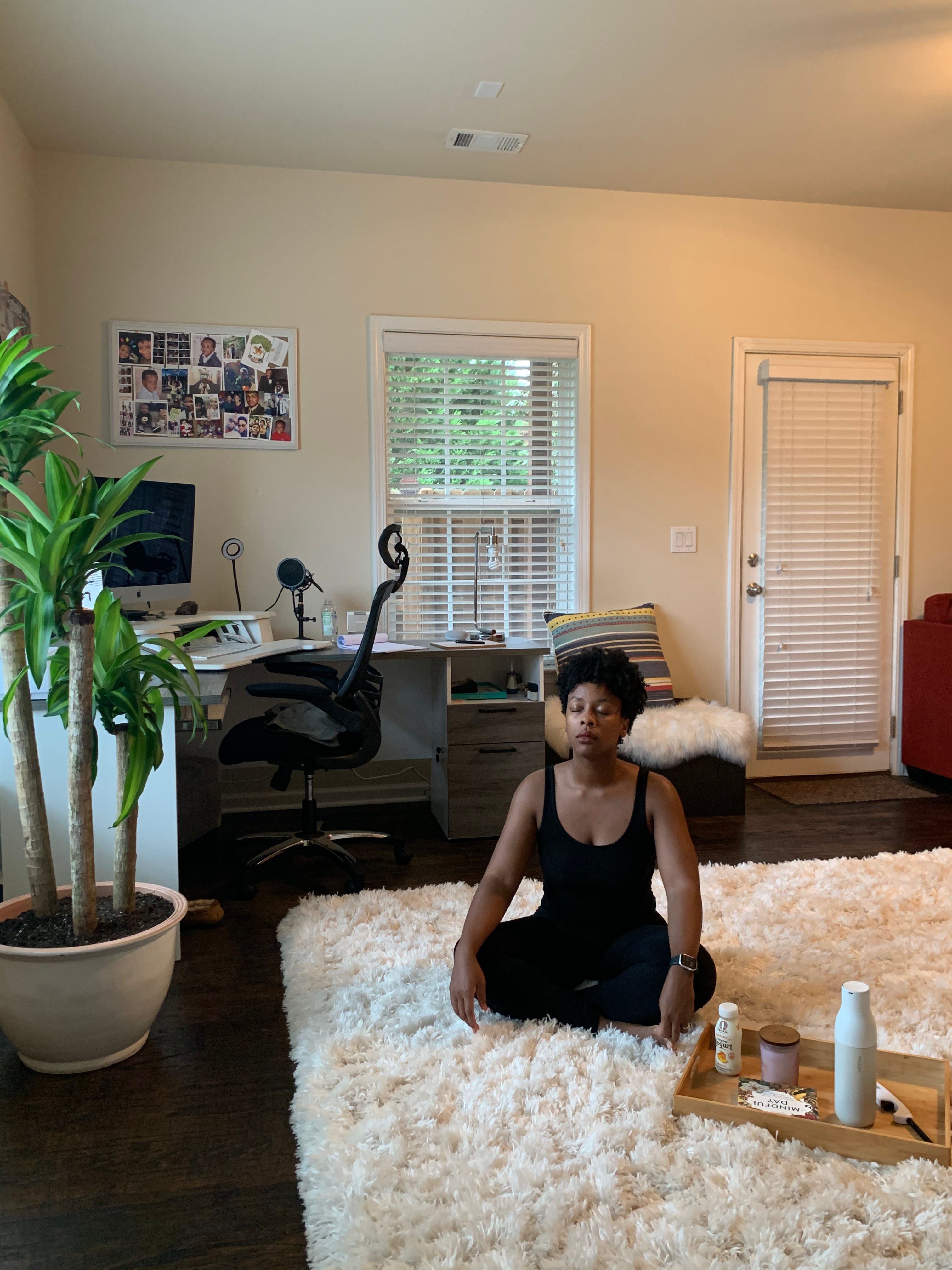
Not completely lost. But... muffled. Like I was living my life with the volume turned down on the parts of it that were supposed to feel like me. I’d go through a whole week and realize I hadn’t been fully present for any of it. I was producing my life. I wasn’t living inside it.
What I know now that I didn’t know then: the tools weren’t wrong. I just didn’t understand yet that my nervous system had a specific language, and I’d been answering it in the wrong one.
Here’s what I’ve come to understand after years of watching women (including myself) try to recover from stress using solutions that weren’t actually built for them.
Stress isn’t one thing. The way it lives in your body, what triggers it, what makes it worse, what your nervous system is actually asking for when it shuts down or fires up... all of that is different depending on how you’re wired. And we have been handing every woman the same toolkit regardless of what her system actually needs.
That’s why your friend swears by her morning routine and it does nothing for you. That’s why you can do a bath ritual and feel exactly the same coming out as you did going in. That’s why some women need to move to reset, and others need to go completely still. That’s why the quarterly staycation helped me survive but didn’t help me thrive.
The research on this is not soft, and it’s not wellness language or intuition. It’s neuroscience.
Dr. Sonia Lupien’s decades of research on the stress response identified 4 specific triggers that activate our threat system:
novelty
unpredictability
threat to the ego
a loss of sense of control
But here’s what that research also shows — different people are differently sensitive to different triggers. One woman’s nervous system fires hardest when her environment is unpredictable. Another’s goes offline when she can’t move. Another’s shuts down when she loses control of her physical space.
And if you’re a Black woman, the stakes of all of this are higher than anyone has been honest with us about.
Black women carry a biological stress age up to a decade older than our chronological peers.
Dr. Arline Geronimus spent decades documenting what she calls “weathering” the accelerated biological aging that happens in Black women’s bodies as a direct result of chronic stress. Not situational stress, chronic, systemic, life-course stress. The kind that comes from spending years being strong for everyone, absorbing the weight of structural barriers, and being given no real permission to fall apart or slow down.
Research published in Preventive Medicine tracking over 30 years of data found that Black women carry a biological stress age up to a decade older than our chronological peers. Dr. Cheryl Woods-Giscombé named the pattern the Superwoman Schema, the internalized belief that we must always be strong, always be available, and never show need. It doesn’t just feel heavy. It is measurably, physically deteriorating our bodies. I talked about this more in this article.
I’m not saying this to scare you. I’m saying it because this is the part nobody says out loud at the beginning of the wellness conversation, and I think we deserve to know exactly what we’re working with.
So I started paying attention differently.
Not just to what was stressing women out, but to what actually brought them back. And I noticed something: the things that restored one woman completely did almost nothing for another. And when I started looking at the patterns, five distinct nervous system profiles kept emerging.
I call them The Unbothered Types.
The Ritualist is the woman whose nervous system finds safety in sequence and ceremony.

Her morning has an order, her candle has to be lit, her playlist has to be right before the day begins. What looks like being “extra” to everyone else is actually her brain doing something profoundly intelligent — creating predictability in a world that keeps throwing unpredictability at her. Dr. Wendy Wood’s research on habit psychology shows that deeply automated routines literally reduce the brain’s cognitive load and lower baseline cortisol. So she’s not being rigid, she’s regulating.
The Wanderer is the woman who restores through movement and discovery.

She thinks best when she’s in motion. She goes to new places alone and comes back full in a way that has nothing to do with where she went. Neuroscientist Dr. Shane O’Mara documented that self-directed movement activates the brain’s spatial mapping systems and is foundational for neural repair and emotional regulation. When she’s trapped in the same space, same routine, same four walls, her nervous system isn’t just bored. It’s shutting down. Dr. Andrew Huberman’s research on optic flow shows that forward movement with panoramic gaze actually down-regulates the amygdala — the brain’s threat alarm. She doesn’t wander for fun. She wanders to survive.
The Nester is the woman whose home is her whole nervous system.

She invests in her space because she understands, even if she’s never had language for it, that her environment IS her emotional regulator. Environmental psychologists Rachel and Stephen Kaplan found that spaces providing “soft fascination” and predictable containment are essential for mental recovery. When her space is chaotic, invaded, or out of her control, she loses her primary tool for coming back down. She can’t rest anywhere because the place that was supposed to hold her isn’t holding her.
The Sensualist is the woman who lives through her senses first.

She’s always the one who finds the best version of everything — the restaurant, the fabric, the fragrance, the glass. What her nervous system needs is physical presence and sensory richness. But Dr. Bessel van der Kolk’s research on trauma and the body shows that under chronic stress, the brain’s feeling center literally goes dark — the insula shuts down to protect itself. Food starts tasting like nothing, colors look flat, and she moves through her days without actually experiencing them. For a woman whose entire way of being alive runs through her senses, that shutdown is devastating.
The Unplugged is the woman who chose the slower life on purpose.

Physical books. Letters over DMs. She puts her phone face down at dinner with herself. What her nervous system craves is depth, quiet, and uninterrupted presence. Dr. Gloria Mark at UC Irvine found that it takes an average of 23 minutes to fully refocus after a single digital interruption. For a woman wired for depth, that constant fragmentation isn’t just annoying. It’s a relentless assault on the exact condition her nervous system needs to feel safe.
Now here’s the part I really want you to sit with, because I saw the comments on the video and I know some of you were confused by this.
You’re not just 1 of these.
Every single one of these profiles represents a universal human need. We all need rhythm. We all need the freedom to move. We all need a space that holds us. We all need to feel things fully. We all need quiet.
The types aren’t boxes. They’re a dashboard — 5 gauges that tell you what your nervous system is running low on right now.
The woman who is primarily a Ritualist will reach for ceremony first when she’s struggling. But there will be seasons where what she actually needs is to get outside and move — and if she doesn’t know that about herself, she’ll keep lighting the candle and wondering why it isn’t working this time.
This is the whole reason the Banked & Balanced Club rotates through all five types across the year. The solo dates, the self-care rituals, the recipes — they’re not all designed for your primary type. They’re designed to keep pulling you toward the full range of what your nervous system actually needs, not just the things you already know you like. Because sometimes the thing that heals you is the thing you wouldn’t have chosen for yourself.
Here’s what I want you to do next.
If you haven’t taken the Unbothered Type quiz yet, start there. It’s free, it takes about two minutes, and it’ll tell you exactly which nervous system profile is your home base — the one you lead from, the one that’s most likely running on empty right now.
And starting this evening, I’m releasing 5 paid guides in The Savoring Room — one for each type, dropping every day this week. Each one goes deep into the specific stress pattern your type is most vulnerable to, the science behind why it hits you the way it does, and the specific micro-interventions that are actually built for how your nervous system works. Not general wellness advice. Not things that work for everyone. Things that work for you.
If you’re already a Savoring Room member, they’re waiting for you starting this evening.
If you’re not yet — this is a good week to join.
We have been so good at surviving. We have been so faithful about doing the things we were told would help. And so many of us are still walking around feeling like something is slightly off, slightly muffled, slightly missing.
What if it was never about doing more? What if it was about finally understanding the language your own body has been speaking all along?
That’s what this is. That’s what all of it — the types, the club, the guides, the research — is pointing toward.
You’re not broken. You’re just finally getting the right translation.
We’re Unbothered.
Rooted in joy, Latesha ♥️
Sources
Geronimus, A. Weathering: The Extraordinary Stress of Ordinary Life in an Unjust Society — Hachette Book Group
Moore, J.X. et al. Temporal Changes in Allostatic Load Patterns by Age, Race/Ethnicity, and Gender — Preventive Medicine
Woods-Giscombé, C. Superwoman Schema — University of North Carolina at Chapel Hill
Lupien, S. Well Stressed: Manage Stress Before It Manages You — Centre for Studies on Human Stress
Wood, W. Good Habits, Bad Habits: The Science of Making Positive Changes That Stick — Macmillan Publishers
O’Mara, S. In Praise of Walking — W.W. Norton & Company
Huberman, A. Optic Flow and Amygdala Down-Regulation — Huberman Lab, Stanford University School of Medicine
Kaplan, R. & Kaplan, S. The Experience of Nature: A Psychological Perspective — Cambridge University Press
van der Kolk, B. The Body Keeps the Score — Viking Press
Mark, G. Attention Span — Hanover Square Press, UC Irvine