


I was on an electric scooter with my then six-year-old on the front when I realized something had shifted in me.

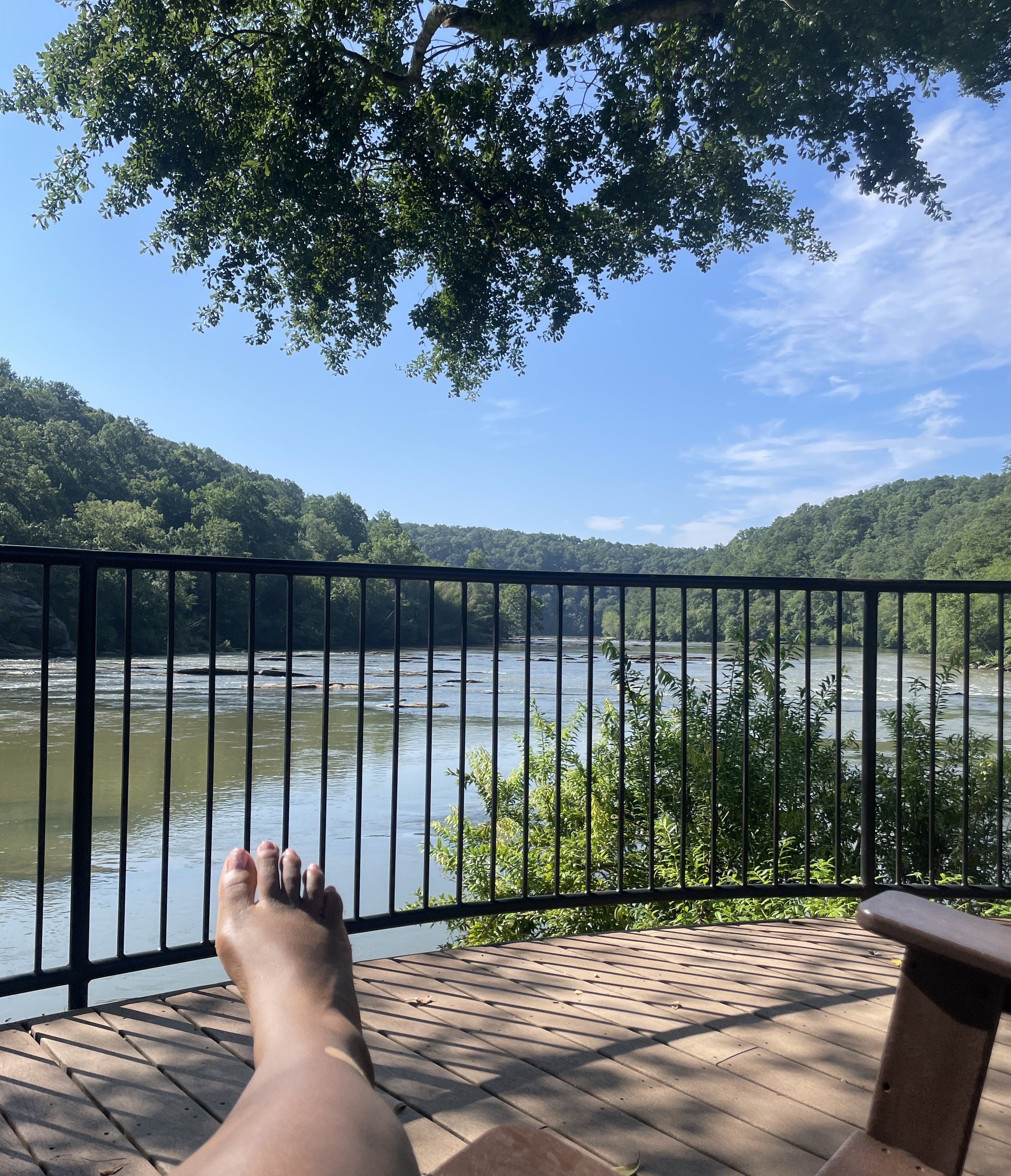
We were riding along the Chattahoochee River trail near the apartment I’d moved into after separating from my husband (for 6 months, we’re fine now 😝). My kid had decided he didn’t want to stay at camp that summer — the separation had been hard on him and switching to a new place felt like too much change at once — so he was home with me, and we had made the river our daily thing. We’d stop and throw rocks, watch the water, let the older people walking together or with their dogs pass us while we sometimes just stood there doing nothing in particular.
My nervous system was deactivating, my cortisol was coming down, and the weathering was, for the first time in years, beginning to slow.
I remember looking at him on the front of that scooter — little and happy despite everything — and feeling something I hadn’t felt in a long time. Not productive gratitude (gratitude journaling used to always tied to a client, a revenue month, an opportunity, something I had earned) this was just... I’m here, the air is warm, my son is laughing, I can feel the water from here, and I have nowhere to be gratitude.
I thought about what my Reiki practitioner had told me — that being near water would be good for my body and my soul specifically, given my energy. I remember thinking, she was right, I can feel it right now.
What I didn’t know then, riding that scooter and smiling at nothing, was that my body was doing something measurable, something the scientists have a name for. My nervous system was deactivating, my cortisol was coming down, and the weathering was, for the first time in years, beginning to slow.
First, let’s talk about what cortisol actually is
Cortisol is your body’s built-in alarm system. When there’s a genuine emergency — real danger, acute threat — a cortisol spike is life-saving. It floods your bloodstream with glucose, heightens your alertness, and suppresses everything your body doesn’t need in that moment: digestion, reproduction, repair.
The problem is that our bodies were not designed to keep the alarm on indefinitely.
And for Black women — millennial Black women especially — the alarm has been on for a long time. Not because we’re weak. Because of what it costs, biologically, to do what we do. Every day. For everyone. Without stopping.
There’s a name for what that cost does to a body. Dr. Arline Geronimus called it weathering.
The research that made my TikTok comments section flood overnight
When I shared the weathering research on TikTok this week, something happened in my comments that I wasn’t fully prepared for. Women started sharing their bodies back to me.
“I’m an 80-year-old. And I’m 53.”
One woman told me she was diagnosed with hypertension at 22. Athletic build. 109 pounds. Active. And still — high blood pressure at 22.
Another said she was burned out by 30 and is now chronically ill.
Someone wrote: “I’m an 80-year-old. And I’m 53.”
The data behind what they were describing is this: at just 20 years old, a Black woman’s body is already carrying the biological stress load of a 30-year-old. That’s not a metaphor — that’s what a 30-year analysis of over 50,000 adults, led by epidemiologist Dr. Justin Xavier Moore, found when measuring allostatic load, which is the scientific term for the cumulative wear and tear that chronic stress puts on the body. (Read the study here.)
By the time we’re in our 30s and 40s — building businesses, raising children, managing households, navigating workplaces that were not built for us — we are aging biologically up to 7.5 years faster than our white peers of the exact same chronological age. The CARDIA study found a 6.1-year biological age gap opening up during the precise years millennial women are trying to establish their lives. (Read the CARDIA study here.)
Not because of genetics. Because of what researchers call high-effort coping. The relentless effort of holding everything together, for everyone, all the time — what Dr. Cheryl Woods-Giscombé named the Superwoman Schema: the perceived obligation to be strong, suppress emotion, resist vulnerability, and never let anyone see you struggle.
The Superwoman Schema keeps the sympathetic nervous system locked in fight-or-flight. Your cortisol stays elevated. Your body never receives the signal that it is safe to rest. And over months and years, that signal failure shows up in your cells.
One woman in my comments, a researcher herself, added that weathering also impacts brain health — contributing to brain fog, memory loss, and dementia-related symptoms in older Black women. Another said she resigned from companies she founded at 48 because 2025 had her looking and feeling 65.
We are not imagining this. Our bodies are keeping score.
What chronic high cortisol actually looks like in your body
Before I tell you what helped me, I want you to be able to recognize what high cortisol looks and feels like — because I lived in it for years and called it normal.
Chronic high cortisol can show up as:
Being wired but tired. Exhausted all day but unable to sleep at night. Your body can’t fully come down because it doesn’t believe the threat is over
Hormonal disruption. Cortisol suppresses progesterone production and disrupts the menstrual cycle, leading to irregular periods, severe PMS, estrogen dominance, and fertility challenges
Unexplained weight changes. Cortisol mobilizes fat into deep visceral stores around the abdomen and increases cravings for high-sugar, high-fat foods because your brain thinks it needs quick fuel to fight a constant invisible threat. It can also cause significant weight loss through the gut — which is exactly what happened to me
Gut chaos. For almost two years, I had IBS-level responses to food every single day. I was having reactions to foods I’d eaten my whole life. Eggs. Dairy. Gluten. My bloodwork kept coming back perfect. My doctor kept saying it must be stress. Multiple people told me it was stress. I didn’t believe them because I thought I was fine. I was not fine. My gut was telling me what my mind refused to accept
Immune depletion and inflammation. Chronic cortisol eventually makes the body resistant to its own anti-inflammatory signals, leading to systemic inflammation and increased risk of autoimmune conditions
Brain fog and exhaustion. High cortisol disrupts deep sleep and REM cycles, and over time actually shrinks the prefrontal cortex — affecting memory, concentration, and emotional regulation
If you want to know your actual numbers, ask your doctor for a 4-point saliva cortisol test. Unlike a standard blood draw, which gives you one snapshot, the saliva test maps your cortisol rhythm throughout an entire day — morning, noon, afternoon, and evening. Cortisol should naturally be highest when you wake and taper down to almost nothing by bedtime. If you’re chronically stressed, your curve may be flat, inverted, or elevated all day. A blood test can miss this entirely. The saliva test shows you the full picture.
What actually helped me — and the science of why it worked
I want to be careful here, because my situation involved choices that not everyone can make. I was an entrepreneur so I could restructure my business. I had the financial stability and support from my parents to separate from my husband temporarily and move somewhere new. I know that is not everyone’s reality.
You cannot regulate a nervous system that is still being actively overwhelmed.
So I’ll tell you what I did, and then I’ll tell you what the underlying biology was — because the biology is what matters, and you can access the same biological responses through different doors.
I removed the root stressors. I slowed my business down, let go of my team, and separated from my husband. Not because I stopped loving him — we healed and we are back together now, and genuinely happier than we have ever been. But at that time, my nervous system needed a circuit breaker. The science here is straightforward: you cannot regulate a nervous system that is still being actively overwhelmed.
I had to stop the continuous triggering of my amygdala before anything else could work.
If you can’t restructure your job or your relationship right now: You can create micro-circuit-breakers. A 10-minute walk outside at lunch. Saying no to one thing this week without explanation. Eating one meal away from your desk. Leaving work at the exact time your shift ends, not when everything is finished — because everything is never finished. These feel small, but biologically, they are not.
I moved near water and spent time outside. My Reiki practitioner told me water would be good for my energy specifically. I didn’t fully understand it then. The science calls it Blue Space — time spent near water lowers cortisol, reduces heart rate and blood pressure, and promotes alpha brain waves associated with relaxed alertness. Green space does similar things. The river trail where I rode that scooter with my kid was not incidental to my healing. It was central to it.
If you don’t live near water or green space: A park counts. A tree-lined street counts. Even a video of moving water has shown measurable calming effects on the nervous system in research settings. Ten minutes outside in natural light does something that ten minutes inside cannot replicate.
Predators don’t sit down to admire a beautiful plate and chew slowly. When you eat like you have time, your body believes you have time.
I chose solitude. The 50/50 custody arrangement I had with my husband that summer gave me something I had not had in years: evenings alone. Nights where no one needed anything from me. Time to sit with my own thoughts without performing for anyone. I didn’t have the language for what that was doing to my body at the time.
The research does: University of Rochester psychologists found that just 15 minutes of intentionally chosen solitude — without devices, without agenda — significantly reduces high-arousal negative emotions like anxiety and anger. The key word is chosen. Forced isolation doesn’t work the same way. When you choose to be alone, it signals safety to your nervous system. It is a biological reset button.
If you don’t have alone time available: Your car is a room. The bathroom with the door locked is a room. Fifteen minutes in either place, phone face down, no agenda. It counts.
When you try something new, your chronically stressed, emotionally flattened brain gets shocked back into aliveness before the experience even fully begins.
I started eating slowly, on real plates. I know this sounds small, but I promise it is not small. I told someone in my comments this week that one of the things that helped me slow down was buying cute plates and eating on them even when no one was coming over, even for snacks, even on a Tuesday. What was happening biologically is that intentional, unhurried eating activates the vagus nerve and signals to your brain that you are safe. Predators don’t sit down to admire a beautiful plate and chew slowly. When you eat like you have time, your body believes you have time. Research published in the MDPI International Journal of Molecular Sciences found that shifting to intentional, unhurried eating patterns lowers urinary cortisol levels and reduces C-reactive protein, a key inflammatory marker. (Read the study here.) It moves your body from fight-or-flight into rest-and-digest, directly repairing gut health.
My gut healed completely, the food allergy-like reactions went away, and my IBS symptoms resolved. I am not a doctor and I am not telling you that eating on a nice plate cured me, but I am telling you that slowing down around food was part of a larger shift that gave my body back to me.
I introduced novelty and play. The scooter, basketball with my kid, skating, things that felt like childhood. Neuroscientists Nico Bunzeck and Emrah Duzel at University College London found that the brain’s midbrain responds to novelty itself — independent of any reward — with a dopamine surge. And neuroscientist Wolfram Schultz at Cambridge established that dopamine neurons fire at the moment of anticipation, not just gratification. When you try something new, your chronically stressed, emotionally flattened brain gets shocked back into aliveness before the experience even fully begins.
The woman in my comments who snuck out of her house without her teenagers, put on a shiesty ass hat, took a ferry to a neighboring town, got fried okra, and sat in a park near the river — she did this intuitively. She gave her brain novelty, solitude, nature, and unhurried eating in one afternoon. Her nervous system didn’t need a prescription, it just needed permission.
I spent time with people where I didn’t have to be strong. My mom, my dad, my friends. People around whom I could take the Superwoman mask completely off. Oxytocin — the bonding hormone released during genuine social connection — directly counters cortisol. It binds to receptors in the brain to downregulate the stress response and create biological safety.
One woman in my comments described her “Crafternoons” with friends — a regular afternoon to work on whatever craft project they’d been putting off. What she described as wonderfully relaxing is, biologically, a cortisol-lowering, oxytocin-producing, dopamine-triggering experience. She built her medicine and called it an afternoon with friends.
If you don’t have a village right now: A pet counts. Research shows that time spent with animals releases oxytocin and measurably lowers cortisol. A nostalgic playlist counts too — the dopamine response triggered by music tied to positive memories works through similar pathways as novelty. One woman in my comments mentioned her iPod with a curated playlist and audiobooks. She had built her own system without knowing the science behind it.
What the gratitude shift taught me
I used to gratitude journal every day in the early years of entrepreneurship, but my gratitude was always tied to output. Revenue. Clients. Opportunities. Things I had produced or earned or achieved.
“Sacrifice doesn’t require numbness.”
On that river trail with my son, I was grateful for the air, for the fact that he was laughing even though things were hard, for the way the water looked. For the older people walking their dogs in the afternoon light while I, someone with a young body and a flexible schedule, got to be there too.
That shift, from gratitude for what I had accomplished to gratitude for what I was experiencing, is not a small thing. It is, I believe now, part of what my nervous system needed to finally believe it was safe. That I didn’t have to keep earning my right to rest. That Tuesday afternoon on the river was enough. That I was enough, not because of what I had built but because I was alive in it.
One of the women in my comments said something that stayed with me: “Sacrifice doesn’t require numbness.”
She’s right, we were never supposed to go numb to survive. We were supposed to be here, fully in our bodies, in our lives, in the ordinary Tuesday moments that add up to everything.
What I built for other Black women because of all of this
In September last year, I created the Banked & Balanced Club a monthly curated Collection for Black women who have decided their joy is non-negotiable. Not someday, now.
Every month members receive in the mail two solo dates (one at home, one out in the world) designed around the exact biological principles I’ve been writing about here. Chosen solitude, novelty, sensory presence, intentional eating. A seasonal food and drink recipe to make slowly, on a real plate, drink out of a real glass, for yourself. Twelve ritual cards across mindset, stress relief, joy, and wellness. And a personal letter that sets the tone for the month.
I didn’t know the science when I built it. I built it from what healed me and just wanted to share that experience with other Black women. And now I know that what healed me has a name, and a body of research behind it, and that it works.
If anything in this article landed for you — if you recognized your body in something I described, or saw yourself in the comments I shared — the Club might be exactly what you’ve been looking for. Not as another thing to add to your list, but as something that makes the list irrelevant for a little while. Every month. In your mailbox.
You can learn more and join at bankedandbalanced.com. Or if you already know your Unbothered Type, you know which pieces of the Collection were made specifically for you.
If you don’t know your type yet, that’s where I’d start. The quiz is free and it takes about three minutes to find the different ways to create joy in your life in ways you’ll actually connect with. You can find it at bankedandbalanced.com/unbothered-type-quiz.
We are the generation that gets to know better. And knowing better means we get to live differently.
We’re Unbothered. Welcome home.
Sources
Moore, J.X. et al. Temporal Changes in Allostatic Load Patterns — Preventive Medicine
CARDIA Study: Racial Differences in Biological Aging — PMC
Geronimus, A. The Weathering Hypothesis — PMC
Woods-Giscombé, C. The Superwoman Schema — Duke University
Bunzeck, N. & Duzel, E. Novelty and Dopamine — University College London
Schultz, W. Dopamine Prediction Error — University of Cambridge
Nguyen, T., Ryan, R. & Deci, E. The Deactivation Effect of Solitude — Personality and Social Psychology Bulletin
Feeding the Rhythm: Cortisol and Intentional Eating — MDPI International Journal of Molecular Sciences
Resonated deeply 🙏🏽
hi there, here from TikTok :) i really enjoyed your academic yet practical approach to this topic. so far i have only seen non-Black women covering this topic (but it could also be because i am relatively new to this platform). thank you for being another voice in the conversation that represents me specifically 😊